How I Found Summerland Cove
This is the story I told at the Wayfinder Schools “Finding Your Way” benefit event on May 1, 2026. Summerland Cove is a fictional place, but it was inspired by a real one, and this is the story of how, on the path toward reinventing my own life and finding my way “home,” I found the cove that inspired my novel SUMMERLAND COVE.
One of the first places I lived when I moved to Maine sixteen years ago from Minnesota after my divorce was a winter rental cottage perched on a hillside overlooking Biscay Pond in Damariscotta. I thought it was the perfect place to start my new, post-married life.
I moved in in December–and in March, when the snow suddenly melted, there was suddenly six inches of water flooding the bathroom floor.
The water was remarkably clean, and isolated to the tiled bathroom. The best possible sort of flood a person could have, I thought. I was in that frame of mind then: that everything about my new life—since I’d clawed my way out of depression to escape the old one—was a miracle.
A plumber was called, and when he came, he talked to me about Maine. There were things he thought I should see. He told me about a place a few miles down the road—a saltwater cove–where hundreds of ducks were spending the winter. He spoke of the sunlight glinting on their iridescent wings and how they would move in a mass, all taking off or landing at once. It was a thing of great beauty to see, he said.
I was not used to plumbers who talked about the iridescence of mallard wings. The first chance I had, I hopped into my Mazda Protégé and set out to look for these ducks.
For my first year or so in Maine, my sensation of miracles was accompanied also by a feeling of being utterly lost in the most exciting way. At the time, I didn’t have GPS. But I’d always loved and studied paper maps, and in each of the dozens of places in the Midwest and Mid-South where I’d lived, I’d always kept a detailed picture in my head of where I was on the map.
I liked to place stories on maps, too, and I would visit places to get a sense of a story’s setting, like the field in northern Illinois where my farmer great-grandfather was killed by lightning in 1912, or the former dance hall in LaCrosse, Wisconsin, where two of my characters, a soldier and a small-town girl, met and fell in love during World War II. So I’d always felt grounded to where I was in a deep, generations-back way.
But the first time I drove to Maine from northern Minnesota in 2010, I had never been here. I knew almost nothing about the place, and I knew no one here. My intuition had simply told me I needed to come. I’d rented a place on Craigslist and driven here through Canada. It was the most direct route, appealing to my practical side.
This wasn’t the first time I’d packed everything I owned into my little car and moved a few hundred or a thousand miles away. It was a sensation I loved back then, those hours or days of being in what I would say to myself was “a nowhere place.”
But my map of Canada showed only major highways, and it took me a couple of days to cross, so I arrived in Maine with the odd feeling that I’d been transported across blank space to end up in an exotic, unknowable land. And that feeling lasted for a very long time.
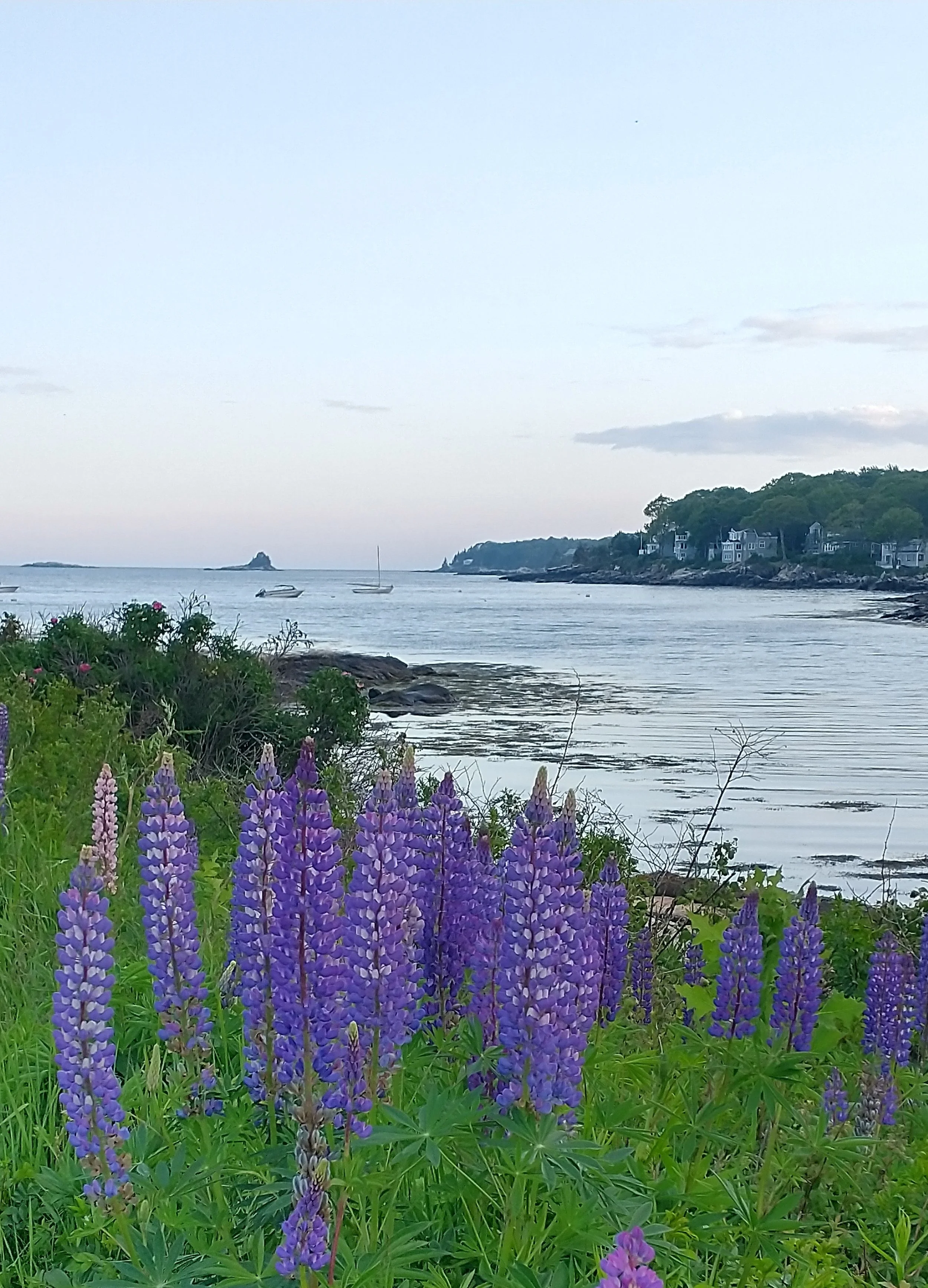
The place that inspired Summerland Cove
So, that spring of 2011, driving from my rented cottage on Biscay Pond out to who knew where to find this cove, I didn’t know what road I was on. I had only the vague notion of how the plumber had told me to find it. I sped along the winding, tree-lined road with a sense of adventure and thrill.
Up and over a hill—and there it was, the water shimmering in the spring sunlight—a narrow cove widening into the distance until it spread out to become the ocean. I slowed down. It was my first time seeing the ocean from this spot, and I was instantly in love—with the vista, with the old summer cottages lining the narrow road, and with the feeling that, on this unpopulated early spring day, it was there just for me. Fresh off divorce, lost, in a nowhere place—yet look where I’d managed to get to!
I saw not a single duck.
So I still don’t know if this cove that I found was the cove that the plumber wanted me to find. Maybe those ducks lived somewhere else.
And then, for about a decade, though I usually didn’t live too far from the cove, I didn’t visit it again. Life was busy, and I was pointed in other directions–no matter how the place had moved me the first time.
But then, for some reason one day, in the early spring of 2023, I went there to take a walk. To see the place. To see the ocean.
I still didn’t see any ducks.
But as I walked the loop around the point past the old summer cottages, I had this feeling, finally, that whatever it was I’d been searching for in all my travels, in the two dozen or so moves I’d made and thousands of miles I’d traveled since 2010, I had finally found it. I had no more need to be “in a nowhere place.” I knew where “home” was now—and I could finally accept this thing that my intuition had seemingly known since 2010, that Midcoast Maine was the place I was supposed to be.
I returned to the cove often during 2023 and ’24, in every season, to walk the loop around the point and take in the ocean view. I started to try to imagine what it would be like to truly have a home in a place like that. Or to have a family, a place where you incontrovertibly belonged. A magical, breathtaking place like the cove. The ways it would hold you or trap you. The ways it would keep you safe. The ways you would love and hate it—but mostly love it. And from there I began to write my novel SUMMERLAND COVE, which will be out June 2.
In this novel, as I’ve done in my life and in other novels, I explore questions of place and belonging. How we become trapped into versions of ourselves, and how these versions of ourselves can sometimes trap us in lives we don’t like, and whether escape and reinvention is truly possible. Whether it’s possible to create a blank page on which to write a fully new story. Or a blank space on a map, a nowhere place, the rise up over a hill to a new vista.
From these questions spring both my novels and my work as a reinvention coach for women ready for change who want to author their next chapter. I believe that if as individuals we can all evolve into the best versions of ourselves–and find a sense of belonging and community–that’s what, in the end, can save us and save this world we live in.
Not to mention save the moments of beauty that the world can provide the soul: The rise up over the hill, the iridescence of mallard wings.